
Wildebeest migration: your questions answered here
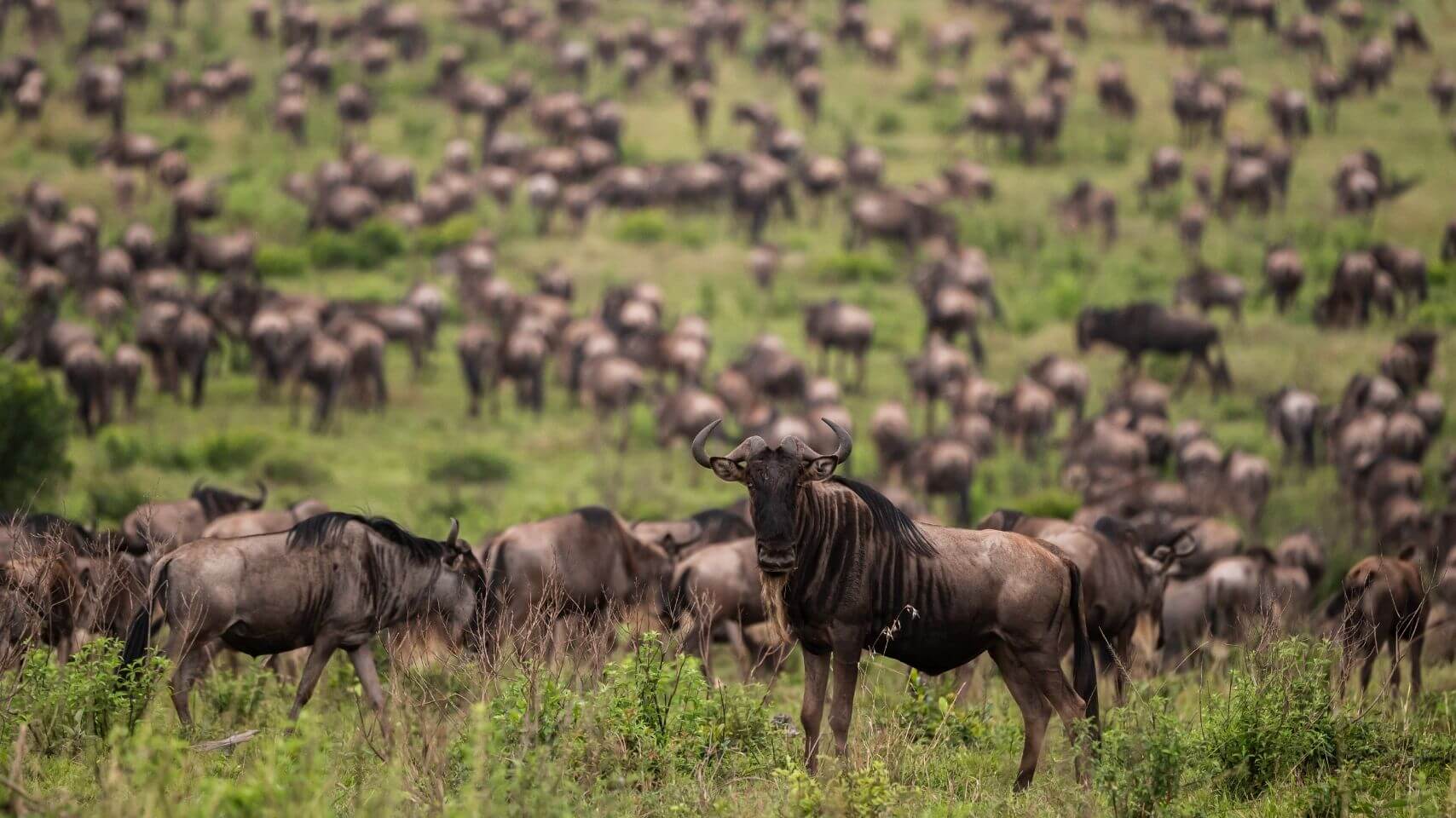
Among the most spectacular events in the world, the Great Migration undoubtedly ranks at the very top.
This is the immense annual migration of millions of wildebeests, zebras, and gazelles that move in vast herds across the Serengeti and into Kenya’s Maasai Mara National Reserve.
This is not a single event, but rather a continuous circular movement along a route that stretches between 500 and 620 miles (800 and 1,000 km).
Following the rhythm of seasonal rains, the animals move as one, searching for fresh grazing areas and places to rest briefly, guided solely by their extraordinary instinct for survival.
A breathtaking spectacle that draws visitors from all over the world each year, eager to witness a long and demanding journey where predators and countless unforeseen challenges are ready to obstruct every step.
Why do wildebeest migrate?
What drives millions of animals through the Great Migration? Survival.
From December to March, the herds gather on the southern Serengeti plains (near Ndutu and the Ngorongoro Conservation Area).
Here, the soil is exceptionally fertile thanks to volcanic ash, producing short, mineral-rich grass that is essential for pregnant and nursing females.
Between April and November, when the rain stops, the herds are guided by instinct northwards, where they find wetter conditions and taller pastures, escaping the advancing drought.
Wildebeest migration facts
Before diving deeper into the circular route of the Great Migration, here are some remarkable facts that highlight the scale, complexity, and ecological importance of this extraordinary natural phenomenon.
- It is the largest land migration in the world, involving around 2 million mammals;
- Wildebeests regenerate the grazing lands, draw predators away from livestock, and, in Masai culture, guide seasons and routes, becoming an essential part of the territory’s natural and spiritual balance;
- Migration may not be the most accurate term for this massive movement of animals: there is no real beginning or end, and their movements simply follow food and water. It is, in fact, a form of true nomadism;
- The route can vary from year to year, as it is shaped by natural factors. Wildebeests mark their path with scent trails that help the herd follow one another;
- In the Southern Serengeti, around 400,000 wildebeests are estimated to be present during the calving season;
- Around 1,3 million wildebeests take part in the migration, and of these, about 250,000 die from hunger, thirst, or dangerous predators;
- Newborn wildebeests can run alongside their mothers within minutes and reach speeds of up to 40 mph (65 km/h).
- Harmony among the different species depends on their distinct feeding habits: each one prefers different parts of the same grass, avoiding direct competition;
- Wildebeests are a primary prey for lions, spotted hyenas, leopards, crocodiles, and cheetahs. An adult lion can eat up to one fifth of an adult wildebeest (around 440 lbs or 200 kg) in a single meal.
How many wildebeest are in the great migration?
In the 1970s, it was estimated that around 1,3 million wildebeests moved in compact herds during the Great Migration.
A recent satellite-based analysis, however, suggests that fewer than 600,000 individuals may actually cross the Serengeti–Mara landscape each year.
Modern technologies still leave room for uncertainty, as the use of AI can produce statistical inaccuracies. This is because the animals are constantly on the move, increasing the risk of double counts or missed detections. In 2023, the models recorded just over 530,000 wildebeests.
The drop in numbers compared to the 1970s does not necessarily indicate a population decline but may reflect a shift in migratory routes or in the distribution of the herds.
Understanding this variability is now essential for planning more targeted and effective conservation strategies.
Following the spiral path of the Great Migration
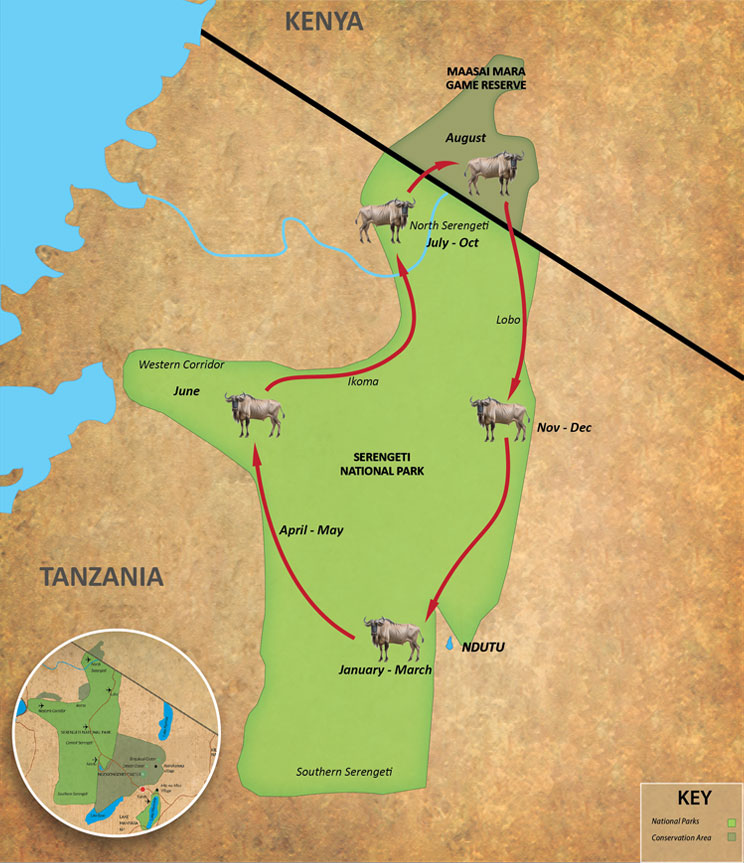
The Wildebeest Migration is a true transhumance, following a clockwise spiral route that is entirely dictated by rainfall patterns.
There is no single “best moment” to witness the Wildebeest Migration, as it is a continuous phenomenon that unfolds across East Africa. This is why there are several ideal periods, each offering a unique and spectacular view of the migration. Each of these windows corresponds to a different phase of the cycle, specifically:
- December–March (Southern Serengeti/Ndutu): during the calving season, the herds gather on the southern plains, where the grass is rich in minerals. This area serves both as the annual starting point and the final return stage of their journey.
- April–May (Central/Western Serengeti): the long rains prompt the herds to move northward, travelling through the central and western corridor of the Serengeti.
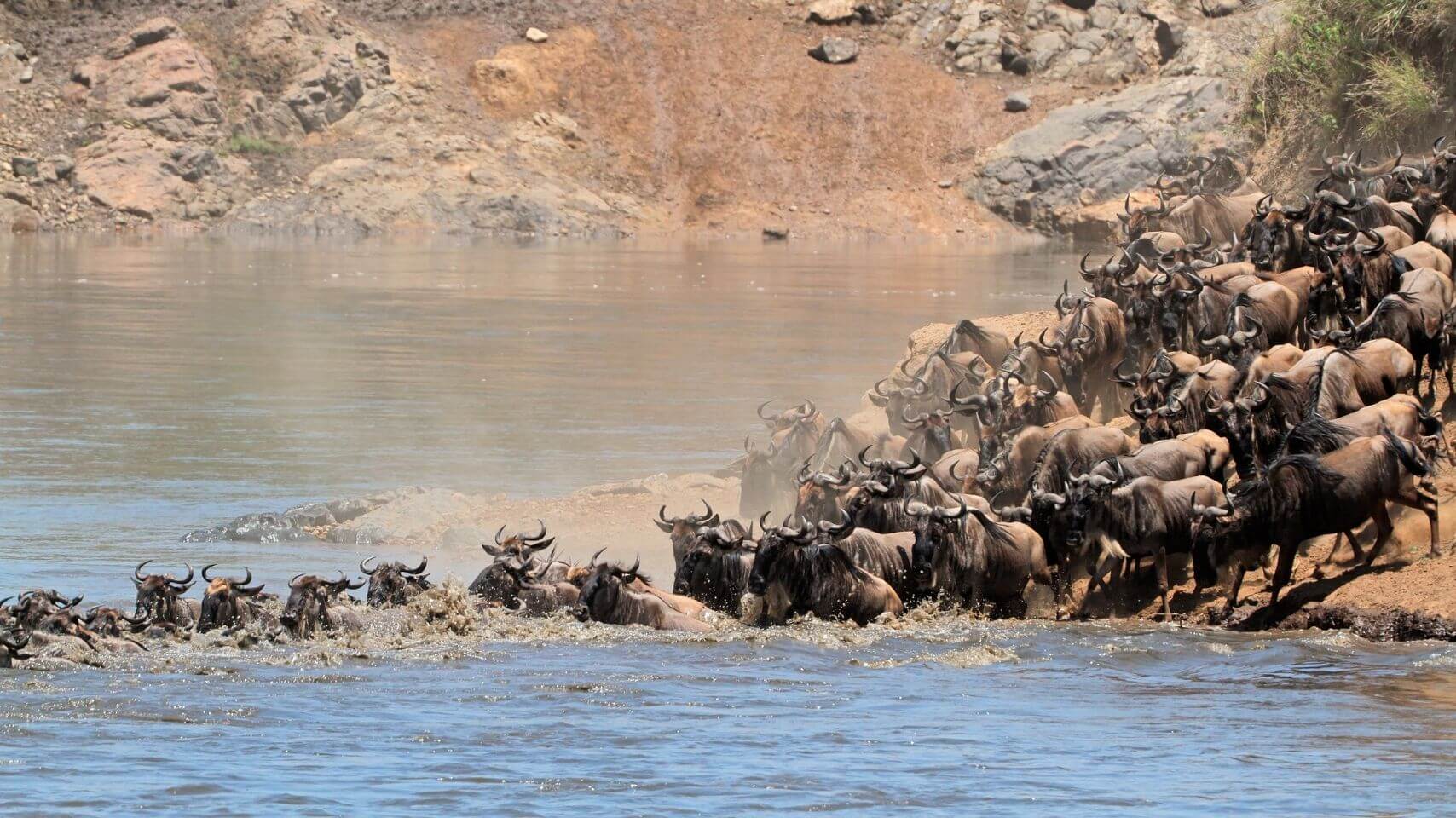
- June–July (Western Serengeti – Grumeti): the wildebeests continue their journey northward and encounter the first major obstacle, the Grumeti River. Here, dangerous predators—large Nile crocodiles—lie in wait.
- August–November (Northern Serengeti – Maasai Mara): here, in the Kogatende region, the herds prepare to cross the Mara River. Part of the migration then moves into Kenya’s Maasai Mara National Reserve, recrossing the river and gradually beginning the journey southward.
Travel along the rhythm of the Migration
Witnessing the Great Migration in Tanzania means stepping into a living, ever-changing masterpiece, an endless flow of life shaped by seasons, instinct and ancient routes carved into the land.
Every month reveals a different scene: the first steps of newborn calves on the southern plains, the long columns marching across the central Serengeti, or the heart-stopping river crossings in the far north.
With Zohar African Safaris, you can experience this spectacle exactly where it unfolds.
Available throughout the year, our itineraries follow the natural cycle of the herds, ensuring you’re in the right place at the right moment. That means standing at the edge of the Mara River or watching thousands of wildebeests blanket the horizon at dawn.
Each journey is guided by knowledgeable experts and can be customized to match your interests, from immersive game drives to extended explorations of the Serengeti, Ndutu and the Ngorongoro Crater.
What remains constant is the feeling: a sense of awe that grows with every landscape, every encounter and every sound of the savannah.