
Tanzania tribes: a journey into culture, history and traditions
Tanzania is a vibrant country, rich in diversity and shaped by an incredible interconnectedness born from its extraordinary cultural variety. In fact, there are many different ethnic groups, yet unity and national harmony remain a constant hallmark.
Bantu, Nilotic, and other ethnicities make a journey through Tanzania a truly unique and enriching experience.
Through this blog, we’ll explore the many tribes that inhabit the country, their traditions, customs, and lifestyles, in a journey filled with heritage and color.
Join us as we discover and celebrate Tanzania’s rich cultural tapestry together.
How many tribes are in Tanzania?
We could describe Tanzania as an ethnic mosaic of more than 120 distinct groups. Despite this remarkable diversity, the tribes coexist in a harmonious and civil way, united by a single official language: Swahili.
These ethnic groups are generally classified according to their linguistic roots:
- the majority, including the Sukuma, the Chagga, and the Haya, belong to the Bantu group;
- there are also Nilotic-speaking groups, such as the Maasai and the Datoga;
- there are small indigenous Khoisan-speaking groups, known for their use of click sounds, such as the Hadzabe.
Let’s now take a closer look and dive into the heart of Tanzania’s ethnic diversity.
Hadzabe tribe
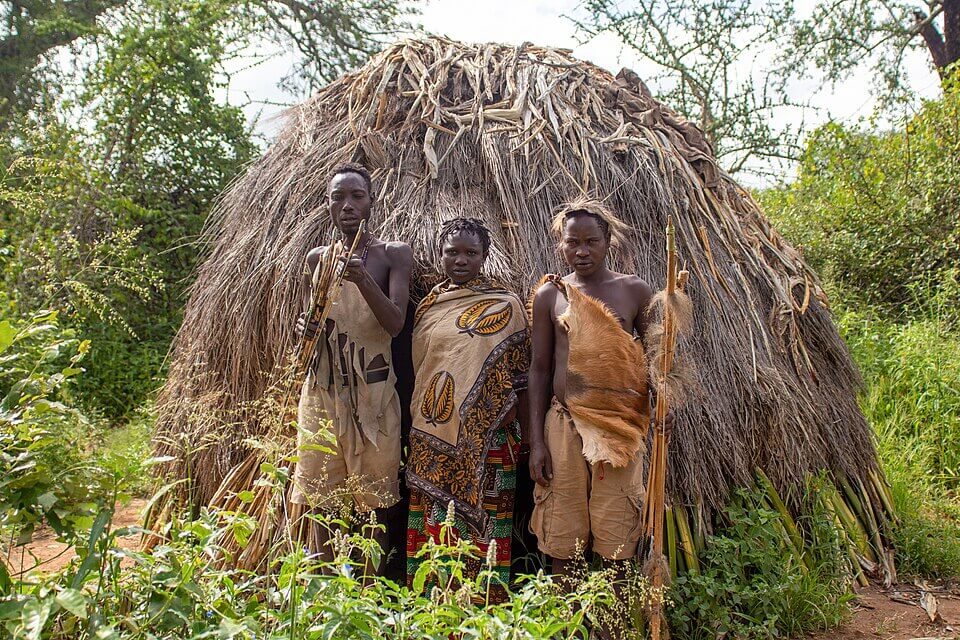
Among the tribes that inhabit Tanzania, the Hadzabe (or Hadza) are certainly the most fascinating and the only ones to preserve an authentic hunter-gatherer lifestyle.
What does this mean? The Hadzabe continue to live in a way that has defined humankind since its very origins. They do not farm, sow, or raise livestock, and their food comes directly from what nature provides each day.
Using bows and arrows, they hunt game, complementing it with other sources of sustenance such as roots, tubers, and edible wild fruits. Hunting is carried out by men, while gathering is the responsibility of women.
This independence makes the Hadzabe semi-nomadic as they move regularly, following available resources and the rhythms of nature. Their camps are therefore temporary, built with simple shelters made of grass and branches, or set up in caves.
The Hadzabe do not follow hierarchical structures and have no formal leader. Instead, decisions are reached collectively, with every member of the group taking part in the process. They do not accumulate wealth or permanent material possessions, and all individuals are treated as equals.
This tribe lives in symbiosis with the savannah, without altering it, but respecting it, guided by ancient knowledge, traditions, and wisdom passed down through generations.
Maasai tribe
The Maasai are the most well-known ethnic group in East Africa, a clear symbol of a warrior and pastoral culture.
They live primarily in the Rift Valley, near the famous Ngorongoro, Tarangire, and northern Serengeti parks. Their livelihood centers on cattle herding (mainly cows), which are considered sacred and serve as the primary measure of wealth and social status.
As semi-nomads, they move in rhythm with their livestock. They reside in bomas, fenced-in villages where women build their characteristic oval or rectangular huts using mud, dung, and branches.
Among the most distinctive features of the Maasai is the shuka, the traditional garment wrapped around the body, most often in red. The typical color symbolizes blood, courage, and protection against enemies and predators. Both men and women adorn themselves with jewelry, whose shapes and patterns reflect age, marital status, and social standing.
Datoga tribe
A semi-nomadic Nilotic population, the Datoga see their livestock as both their wealth and their social identity.
Unlike other tribes, the Datoga are skilled blacksmiths, an activity that allows them to forge tools and implements, as well as the arrowheads later used by the Hadzabe.
Women wear decorated leather garments, and their faces are marked with distinctive tattoos. Around their wrists, they adorn themselves with numerous brass and copper bracelets.
Their craftsmanship and resilience keep alive one of the most distinctive cultural legacies in Tanzania.
Chagga tribe
Closely tied to Mount Kilimanjaro, the Chagga (or Wachagga) are the third-largest ethnic group in Tanzania. Known for being hardworking, educated, and economically successful, they devote themselves to intensive agriculture, taking advantage of the region’s fertile land.
They are producers of coffee (an important export crop) and bananas, which form the basis of their diet.
One iconic product is mbege, a traditional, slightly alcoholic beverage made from bananas and sprouted millet.
Beyond their agricultural heritage, the Chagga were traditionally organized into kingdoms ruled by chiefs (Mangi), and their ingenuity can still be seen in the ancient irrigation systems they developed along the mountain’s slopes.
Haya tribe
Settled in the Kagera region along the western shores of Lake Victoria, the Haya were historically organized into small kingdoms (such as Kiziba, Kyamtwara, and Ihangiro), each ruled by a sovereign known as the Mukama. Agriculture forms the backbone of their economy, with coffee as their main crop, though they also engage in fishing and livestock keeping.
Remarkably, the Haya are known as one of the first African peoples (and possibly in the world) to have developed carbon steel production nearly 2,000 years ago, using preheated furnaces. Their traditional houses are typically wall-less, built in a distinctive beehive shape, with a thatched roof that extends all the way to the ground.
Sukuma tribe
While the Haya are remembered for their ingenuity in agriculture and early metallurgy, the Sukuma stand out for their cultural vibrancy and spectacular dance tradition.
The largest ethnic group in the nation is the Sukuma, who make up about 16% of the total population. They live mainly south of Lake Victoria, in the Mwanza and Shinyanga regions, relying on both agriculture and livestock. Their main cash crop is cotton, but the tribe is best known for its vibrant dance traditions.
One of the most famous and spectacular performances is the Bugobogobo, or “Snake Dance,” in which dancers, often traditional healers known as Nyamgagana, perform with live snakes, including pythons, as part of spiritual and medicinal rituals.
Iraqw tribe
The Iraqw (also known as Wambulu) are distinguished by their language, classified as Southern Cushitic, a rarity in Tanzania, where Bantu and Nilotic languages prevail. Settled in the Mbulu Highlands and the Karatu area, near the Ngorongoro Crater and Lake Manyara, they have historically occupied this region as a means of defense against Nilotic pastoralist groups.
They rely on intensive agriculture, producing mainly maize, beans, and potatoes, and they are also livestock keepers. Their customs reflect the need to defend themselves from other tribes, such as the Maasai, which is why their houses, for example, are built semi-subterranean, designed to protect both family and livestock.
Rooted in history and tradition, the Iraqw continue to embody the strength of Tanzania’s cultural diversity.
Extending your journey: more tribes and traditions
Tanzania’s social fabric is remarkably vast and, beyond the tribes already mentioned, we also find the Pare, whose culture is closely tied to the mountains and the sacredness of the forests.
There are also the Kurya, divided into different clans and known for their circumcision practices. The Jita, who live along the shores of Lake Victoria, rely on fishing and agriculture, while the Hangaza speak a language closely related to those spoken in Rwanda and Burundi, with which they share a border.
Finally, there are the Cushites, the Rangi and the Nyasa, who have had a significant historical impact on the southern part of the country, and the Makonde, renowned for their sculptures, worldwide known as Makonde Art.
Unlike most Bantu and Nilotic groups in Tanzania (which are patrilineal, where descent is traced through the father), the Makonde are a matrilineal society. This means that descent, inheritance, or membership in a social group is passed through the maternal line rather than the paternal one.
Connecting with people, not just places
We could observe the richness and cultural depth of Tanzania, and how it is shaped by the different regions of the country. Zohar African Safaris offers visits to these ethnic groups, designed as a true cross-cultural experience that enriches your journey through authentic immersion.
The tours allow for intimate and meaningful interaction, guided by members of the local community.
By choosing Zohar, you will not only explore Tanzania’s breathtaking wildlife and vibrant landscapes, but also experience meaningful encounters with local communities, supporting projects that preserve traditions and safeguard cultural heritage.